

The Coat of Arms of Nîmes
Palm Trees and Crocodiles
The ace of Nîmes
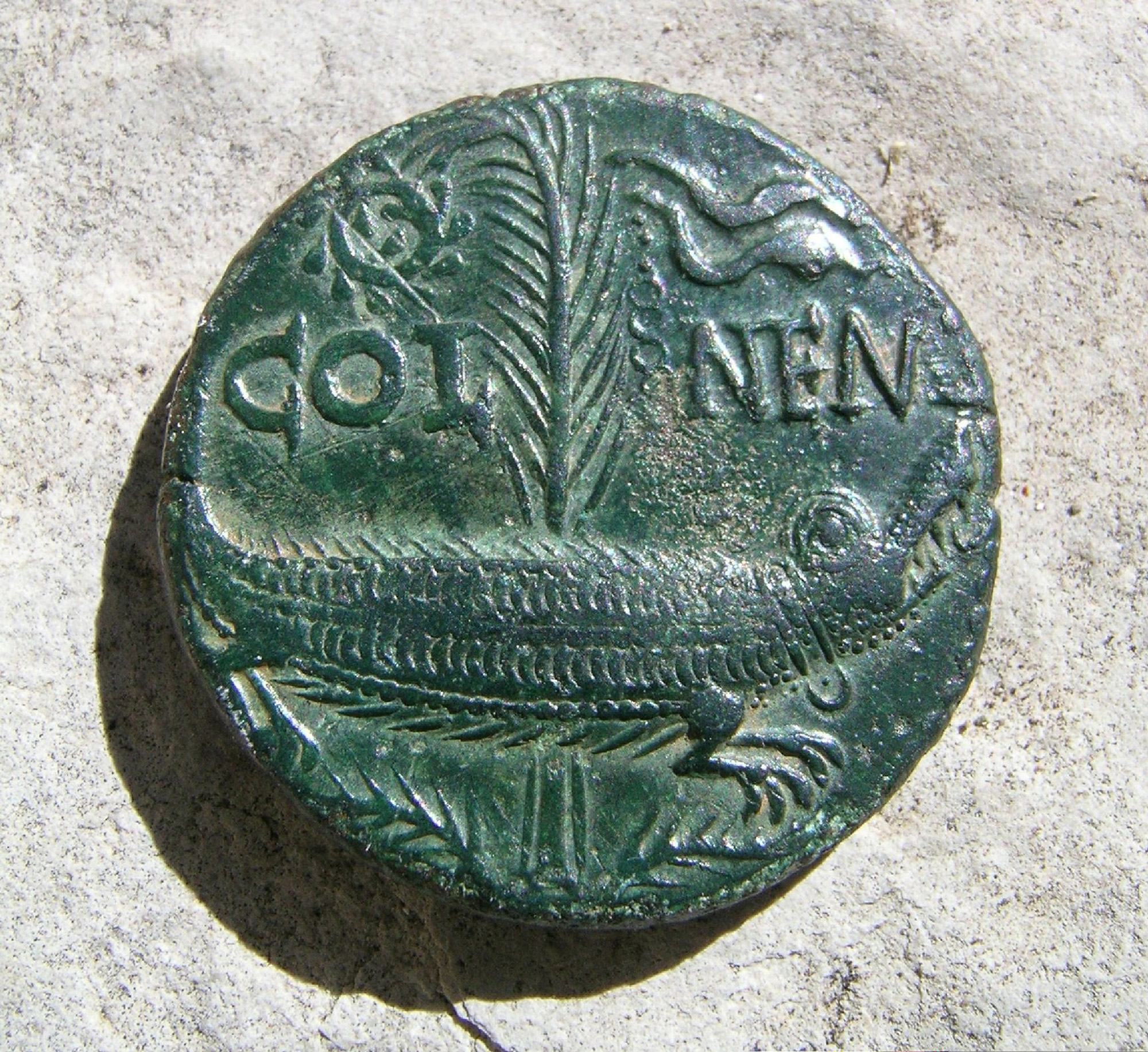
During the Roman era, the city of Nemausus produced a coin, a dupondus, commonly known, erroneously, as the "Ace of Nîmes" (the ace is a monetary value worth half a dupondus), to commemorate Octavian's victory over Mark Antony and Cleopatra at the Battle of Actium in 31 BC. This victory enabled Julius Caesar's adopted son to take control of Rome and radically change the Republic to establish the Empire. He took the name Augusta.
The coin depicts subjugated Egypt with a crocodile chained to a palm. The crocodile, a common sight on the banks of the Nile, personifies Egypt, while the palm is an ancient symbol of victory. The other side depicts Octavian-Augustus and Agrippa, the great victors of the battle.

The Coat of Arms
In the 16th century, when King Francis I visited Nîmes, the consuls requested permission to use the Roman coin as the city’s emblem. The king granted his approval in a letter dated 1535. One change was made: the palm tree replaced the palm frond. From that point on, between the 16th and 18th centuries, several patrons purchased real crocodiles to adorn the consular house. These four crocodiles now hang from the ceiling in the stairwell of the current City Hall.
Artistic Interpretations
In 1986, the City of Nîmes commissioned the architectural and design firm of Philippe Starck to modernize the city’s coat of arms. Today, his version can be found throughout the city in the form of studs embedded in the ground or mounted on street bollards. He also designed a bus shelter inspired by the coat of arms.
Visual artist Martial Raysse redesigned the market square, where he reimagined the city’s coat of arms by separating its bronze crocodile statue from a real palm tree.
Avignon-based painter Dominique Durand created a trompe l’œil image of a crocodile at a window above one of the busiest shopping streets in the city center.


